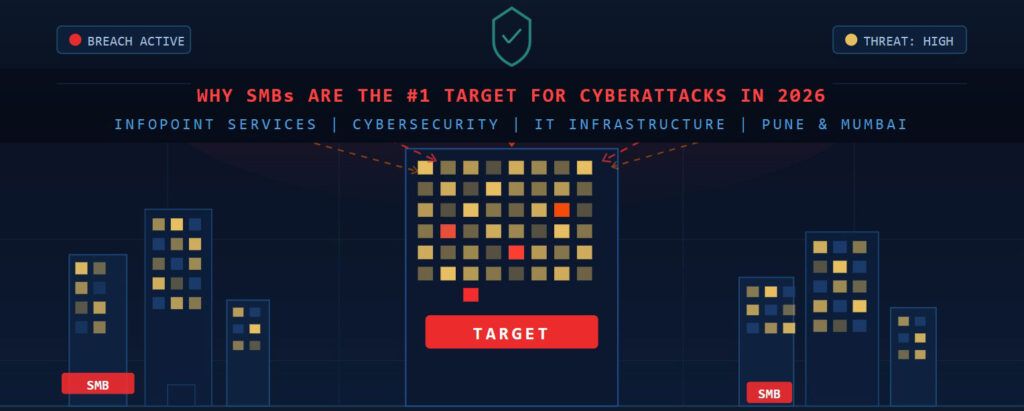
Why SMBs Are the #1 Target for Cyberattacks in 2026: The InfoPoint Security Report
Published by: InfoPoint Services | Managed IT & Cybersecurity Experts
Service Areas: Pune, Mumbai, and Pan-India
Last Updated: May 13, 2026
🚀 Executive Summary: The 2026 SMB Threat Landscape
In 2026, cybersecurity is no longer a luxury—it is a business-critical investment for Small and Medium Businesses (SMBs). While large enterprises have fortified their perimeters, 60% of all global cyberattacks now target SMBs. This shift is particularly aggressive in high-growth hubs like Pune and Mumbai, where digital transformation and cloud adoption are at an all-time high.
🔓 Why Cybercriminals Choose SMBs (The “Hard Truth” Analysis)
Cybercriminals are strategic; they seek the path of least resistance with the highest reward. Attackers target SMBs because of predictable vulnerabilities:
- Underfunded Defenses: Most SMBs allocate less than 5% of their IT budget to security, creating massive gaps in infrastructure.
- The “Security Gap”: Unlike large corporations, SMBs rarely maintain an in-house, 24/7 Security Operations Center (SOC).
- Legacy Systems: Outdated software, unpatched web applications, and neglected CMS plugins are the most common entry points for hackers.
- Human Vulnerability: Lack of quarterly employee training makes staff easy targets for hyper-personalized social engineering.
- Supply Chain Backdoors: Attackers use SMBs as a “stepping stone” to reach larger partner corporations through shared software portals.
⚠️ High-Risk Assets: What is Being Targeted in 2026?
Our recent audits of firms across Maharashtra show that attackers are prioritizing:
- Financial & ERP Systems: Banking portals, payroll platforms, and accounting software.
- Customer Databases (CRM): Personal Identifiable Information (PII) and transaction history.
- Web & E-commerce Portals: Customer-facing platforms exposed to SQL injections and DDoS attacks.
- Remote Work Infrastructure: Unsecured cloud storage, weak API keys, and employee endpoints.
👾 Modern Attack Methodologies: The 2026 Threat Kit
- Ransomware-as-a-Service (RaaS): Organized syndicates now sell subscription-based encryption kits to low-skill attackers.
- AI-Generated Spear Phishing: Hyper-personalized emails crafted using scraped LinkedIn and social data to impersonate CEOs or vendors.
- Zero-Day Exploits: Targeting unpatched vulnerabilities in popular plugins before a fix is released.
- Living-off-the-Land (LotL): Attackers use legitimate IT tools already in your system to hide their tracks and exfiltrate data.
🛡️ The 2026 SMB Defence Checklist: How to Fight Back
To reduce your risk exposure by up to 90%, InfoPoint Services recommends these foundational measures:
- ✅ Deploy EDR: Use Endpoint Detection & Response on every business device.
- ✅ Enforce MFA: Multi-Factor Authentication is mandatory for all email and cloud accounts.
- ✅ Zero Trust Architecture: Adopt a “never trust, always verify” approach for all network access.
- ✅ The 3-2-1 Backup Rule: Maintain 3 copies of data, on 2 different media, with 1 offsite/cloud copy.
- ✅ Continuous Monitoring: Conduct regular vulnerability assessments and penetration testing.
- ✅ Website Hardening: Implement Web Application Firewalls (WAF) and SSL encryption.
🚀 Why Partner with InfoPoint Services?
At InfoPoint Services, we understand that no two businesses face the same threat profile. That’s why our cybersecurity approach begins not with a generic checklist, but with a deep, AI-assisted landscape analysis of your entire business environment. Our team of seasoned cybersecurity and IT infrastructure specialists conducts a comprehensive audit of your IT infrastructure, software stack, website, web applications, network architecture, user access controls, and third-party integrations — combining advanced diagnostic tools and AI-powered threat modelling with years of hands-on expertise. Based on this analysis, we design and implement a customized, layered security framework that fits your business size, industry, compliance requirements, and budget.
From deploying next-gen firewalls, SIEM platforms, and endpoint protection to hardening your website and web development environments, securing your cloud, and training your team — InfoPoint Services delivers end-to-end cybersecurity as a managed, proactive service. Businesses across Pune, Mumbai, and beyond trust us to keep their operations, data, and reputation safe in an era where cyber threats evolve daily. Don’t wait for a breach to act — contact InfoPoint Services today for a free cybersecurity consultation and take the first step toward a resilient, secure business.
Protect your data. Protect your reputation. Protect your future.
📩 Secure Your Business Today
Ready for a resilient digital environment?
👉 Book Your Free 2026 Cybersecurity Consultation
📍 Serving Mumbai, Pune, and across India
#Cybersecurity #ITServices #SMBSecurity #InfoPointServices #PuneBusiness #MumbaiIT #WebDevelopment #RansomwareDefense #CloudSecurity
Frequently Asked Questions
Multi-Factor Authentication (MFA) requires two or more pieces of evidence to log in (e.g., a password + a code on your phone). Why? Because 90% of breaches start with a stolen password. Even if a hacker has your password, they cannot access your account without that second physical “factor.”
AI phishing is hyper-personalized and lacks the “bad grammar” of the past. Prevention requires AI-driven email security tools that analyze communication patterns and “intent” rather than just looking for malicious links. Regular Phishing Simulation Training for employees is also vital.
Check for:
- Sender Address: Does it match the official domain? (e.g., info@microsoft-security.com vs info@microsoft.com).
- Urgency: Does it demand immediate action to “prevent account suspension”?
- Links: Hover over links to see the actual URL destination.
Cloud security relies on the “Shared Responsibility Model.” Use Cloud Access Security Brokers (CASBs), ensure all “buckets” are private, rotate API keys frequently, and use automated tools to scan for misconfigurations in AWS, Azure, or Google Cloud.
Start with foundational certifications (CompTIA Security+ or GSEC), then specialize in high-demand 2026 fields like Cloud Security, AI-Threat Intelligence, or DevSecOps. Hands-on experience with tools like SIEM platforms and Python scripting is essential.
IoT devices (cameras, sensors, smart office tech) are often the weakest link. Secure them by placing them on a separate, segmented network, changing all default passwords, and using an IoT-specific discovery tool to monitor for unusual outbound traffic.
No. Traditional antivirus cannot stop AI-driven phishing or “Living-off-the-Land” attacks. You need a managed, proactive approach like EDR and continuous monitoring.
No. In 2026, firewalls are just the “perimeter fence.” Modern attacks (like credential theft or insider threats) happen inside the network. You need a multi-layered approach including EDR, identity management, and encryption to protect data once the perimeter is breached.
It is a proactive plan that includes:
- Detection: Using behavioral AI to spot unusual file encryption patterns.
- Containment: Automatically isolating infected devices from the network.
- Recovery: Restoring from “Air-Gapped” backups that the ransomware couldn’t reach.
A Virtual Private Network (VPN) creates an encrypted “tunnel” for your data. You need one if your employees work remotely or use public Wi-Fi to ensure that sensitive business data isn’t intercepted by “Man-in-the-Middle” attacks.
Zero-Trust assumes that a breach has already occurred. It is implemented by:
- Verifying every user identity (MFA).
- Validating every device.
- Limiting access to only what is necessary (Least Privilege).
- Segmenting your network so an attacker can’t move from one department to another.
Quantum computers threaten to “break” current RSA and ECC encryption. In 2026, businesses are beginning to transition to Post-Quantum Cryptography (PQC)—new encryption standards designed to be secure against quantum attacks.