
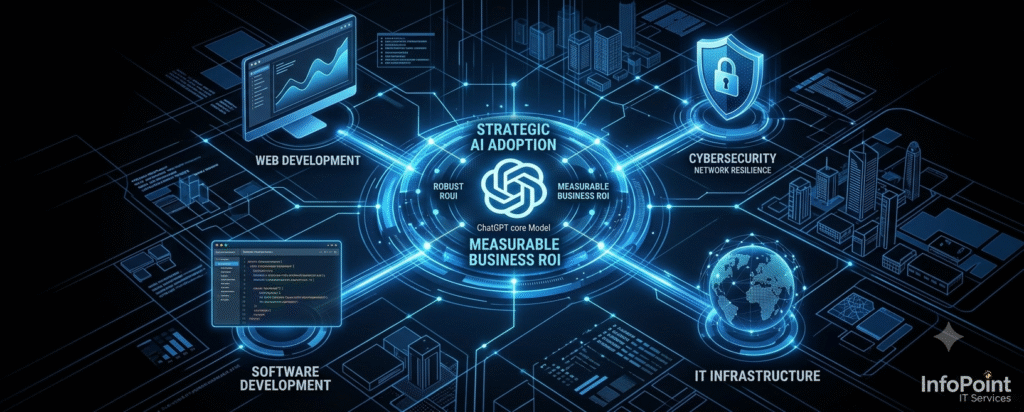
Artificial Intelligence has rapidly evolved from a futuristic concept into a practical business tool transforming how modern organizations operate. At the forefront of this digital shift is ChatGPT—an advanced AI assistant helping companies improve productivity, automate routine tasks, and enhance customer experiences. What began as a conversational AI tool has matured into an enterprise-grade productivity platform capable of supporting marketing, sales, customer service, software development, finance, HR, and IT infrastructure.
Across major economic hubs like Pune and Mumbai, forward-thinking organizations are actively integrating ChatGPT into their daily workflows. Business leaders are no longer asking if they should adopt AI; instead, they want to know where AI can create measurable business value and how quickly they can realize a clear Return on Investment (ROI).
The Global AI Revolution: Driving Business Growth via Modern IT Services
The adoption of Generative AI is accelerating across high-stakes industries, including finance, healthcare, manufacturing, and professional IT services. Organizations recognize that AI is no longer limited to basic automation—it has become a powerful corporate partner that assists teams in solving complex problems, writing software, and protecting critical cybersecurity perimeters.
Several key factors are driving this rapid adoption:
- Cost Efficiency: Increasing pressure to improve output without proportionally escalating workforce or IT infrastructure costs.
- Customer Experience: Growing demand for rapid, personalized responses across every consumer touchpoint.
- Data-Driven Decisions: Rising volumes of enterprise data requiring real-time, intelligent analysis.
- Seamless Tech Alignment: Greater accessibility of AI tools through cloud networks and smooth integration with existing business software.
For companies leveraging expert web development and robust cloud systems, work that previously required days can now be finished in hours, freeing teams to focus on core innovation and scale.
Real Business Use Cases That Deliver High-Impact ROI
One of ChatGPT’s greatest strengths is its sheer versatility. Rather than replacing human talent, it acts as a digital force multiplier across key corporate functions:
1. Web Development & Website Optimization
Engineers and digital marketers are using ChatGPT to accelerate front-end and back-end code creation, generate clear technical documentation, and debug existing applications. When integrated into a company’s core website, ChatGPT can analyze user behavior patterns to optimize landing pages, improve web performance metrics, and enhance overall conversion rates.
2. Marketing & SEO Content Generation
Marketing departments leverage AI to scale production for blogs, social media campaigns, and targeted copy. It significantly reduces initial draft times while ensuring consistent keyword placement to help your website rank higher on search engines.
3. IT Infrastructure & Cybersecurity Operations
In modern network management, ChatGPT assists system administrators by generating configuration scripts, troubleshooting connectivity issues, and summarizing threat intelligence. This allows mid-market and enterprise firms in Mumbai and Pune to maintain resilient IT infrastructure while proactively flagging potential cybersecurity vulnerabilities before they cause downtime.
4. Sales, HR, & Administrative Workflows
Sales teams utilize AI to draft highly personalized outbound emails and pitch decks, drastically cutting down response times. Meanwhile, HR personnel use it to screen resumes and draft onboarding documentation, streamline administrative overhead, and boost internal operational efficiency.
The Reality of AI Adoption: Common Implementation Challenges
Despite the clear financial advantages, deploying AI across an enterprise without a strategic roadmap often leads to fragmented results. Organizations frequently run into structural roadblocks:
- Inconsistent usage and lack of formalized prompt training among staff.
- Severe concerns regarding data privacy, confidentiality, and cybersecurity compliance.
- Technical integration friction between AI models and legacy enterprise software systems.
- Absence of a specialized partner to align AI tools with underlying IT infrastructure.
Strategic Blueprint: Best Practices for Enterprise AI Success
To safely extract maximum business value from AI platforms, companies should follow a structured, multi-phase rollout sequence:
- Phase 1: Assessment – Identify High-Impact Core Processes
Audit your current operational workflows—specifically focusing on customer support, software maintenance, and internal communication channels—to target areas where AI can reduce manual hours. - Phase 2: Risk Management – Enforce Cybersecurity & Governance Policies
Establish strict corporate compliance guidelines. Ensure that any AI platform interacting with your proprietary business data or customer metrics adheres to rigorous security standards. - Phase 3: Technical Execution – Integrate with Existing Software Ecosystems
Connect your AI engines directly to your CRM, ERP, and web applications via secure APIs to prevent data silos and enable automated, real-time data lookups. - Phase 4: Optimization – Train Teams on Prompt Engineering
Provide structured training to your staff on advanced prompting techniques to maximize output accuracy, reduce hallucinations, and drive consistent daily usage.
Why Partner with InfoPoint IT Services for Your AI Transformation?
Successfully launching enterprise AI requires far more than buying a premium software subscription. It demands a deep understanding of legacy systems, API integrations, data privacy laws, and scalable cloud networks.
At InfoPoint IT Services, we bridge the gap between raw AI capabilities and tangible business growth. We begin by evaluating your current operational landscape—including your active software systems, database layers, website performance, and IT infrastructure.
Serving businesses across Pune, Mumbai, and global markets, our specialized teams engineer custom solutions tailored to your unique requirements:
- End-to-End Web Development: Building secure, AI-driven web applications and interactive features that engage visitors and capture leads automatically.
- Robust Cybersecurity Frameworks: Securing your AI pipelines to protect proprietary algorithms and customer datasets from emerging external threats.
- Infrastructure Management: Optimizing your cloud and on-premise IT infrastructure to handle heavy AI workloads seamlessly, ensuring zero operational downtime.
Whether you need to automate your customer touchpoints, deploy enterprise-grade search tools, or integrate ChatGPT with your existing software stack, InfoPoint IT Services delivers measurable, long-term ROI.
Secure Your Competitive Advantage Today
The future belongs to AI-enabled organizations. Don’t leave your digital evolution to chance. Let our technical experts build a secure, intelligent, and scalable AI ecosystem tailored exclusively for your business.
Ready to start? Book an AI Consultation or explore our full suite of Professional IT Services.
Frequently Asked Questions
Yes. India’s tech corridors in Pune and Mumbai are hubs for specialized AI integration firms. Leading IT services providers, like InfoPoint, offer comprehensive AI roadmaps tailored to regional business needs, ensuring that compliance, language barriers, and data localization requirements are met during deployment.
Yes, dramatically. By integrating a specialized ChatGPT-powered assistant into your corporate website, you can provide personalized product recommendations, answer visitor questions in real time, and pre-qualify leads 24/7. This proactive engagement significantly lowers bounce rates and guiding users toward your conversion goals more efficiently than traditional static forms.
Software engineering teams are leveraging ChatGPT as an expert “pair programmer.” It is highly effective at drafting boiler-plate code, explaining complex legacy functions, generating comprehensive unit tests, and identifying security vulnerabilities in source code. When guided by experienced developers, AI accelerates the entire software development lifecycle (SDLC), allowing products to move from concept to deployment faster.
ChatGPT is rarely deployed in isolation. The highest value comes from connecting its API directly into your standard business software, including CRM, ERP, and web content management systems (CMS). Through secure API endpoints, ChatGPT can fetch, analyze, and generate data within your existing workflows, enabling a seamless automation layer across the entire organization.
While ChatGPT is not a standalone security tool, it strengthens a company’s overall cybersecurity posture. Security teams use it to:
- Summarize Threat Intelligence: Rapidly analyzing massive security logs to identify patterns of attack.
- Automate Documentation: Generating standard incident response reports and security policies.
- Analyze Phishing: Inspecting suspicious emails for malicious indicators at scale.
ChatGPT has evolved from a simple chatbot into a powerful force multiplier for enterprise IT services. Businesses are leveraging its API to develop custom automation tools, enhance real-time technical documentation, and deploy intelligent ticketing systems. This technology enables teams to move beyond manual task management and focus on scaling their digital growth.
Data privacy and compliance are the most critical risks when using public models. If proprietary source code, client financial data, or sensitive internal documents are entered into public models without secure API architecture, that data can become leaked or used for training. Secure business implementation requires a specialized architecture—like a private instance or rigorous data masking—that keeps proprietary data entirely within your controlled web development environment.
Businesses achieve the fastest Return on Investment (ROI) by applying ChatGPT to repetitive, high-volume tasks. Top use cases include:
- Web Development & Code Generation: Drastically reducing engineering time by drafting and debugging front-end and back-end code.
- Marketing Automation: Scaling high-quality content production for blogs, emails, and web copy.
- Customer Support: Deploying 24/7 intelligent virtual assistants to handle standard inquiries instantly.
To measure the financial success of an AI initiative, track these key performance indicators (KPIs):
- Efficiency Gains: The reduction in manual hours spent on tasks like coding, writing software, or draft generation.
- Response Time Improvement: Decrease in customer support resolution time.
- Conversion Increase: Measurable rise in qualified leads or sales generated via an AI-powered website assistant.
In modern IT infrastructure environments, ChatGPT acts as an intelligent force multiplier for DevOps and system administrators. It is used to generate complex infrastructure-as-code (IaC) scripts, troubleshoot network configuration errors instantly, and maintain exhaustive documentation of server environments. This allows for faster deployment cycles and reduced downtime caused by configuration management errors.